The Rift VR headset, particularly the Oculus Rift S, was a pioneering series of PC-tethered virtual reality devices that significantly advanced consumer VR from 2016 to 2021. It introduced key innovations like inside-out tracking and the Guardian system, making high-fidelity VR more accessible. While discontinued, its legacy profoundly shaped modern VR technology, though it is not recommended for purchase today due to outdated technology and lack of support.
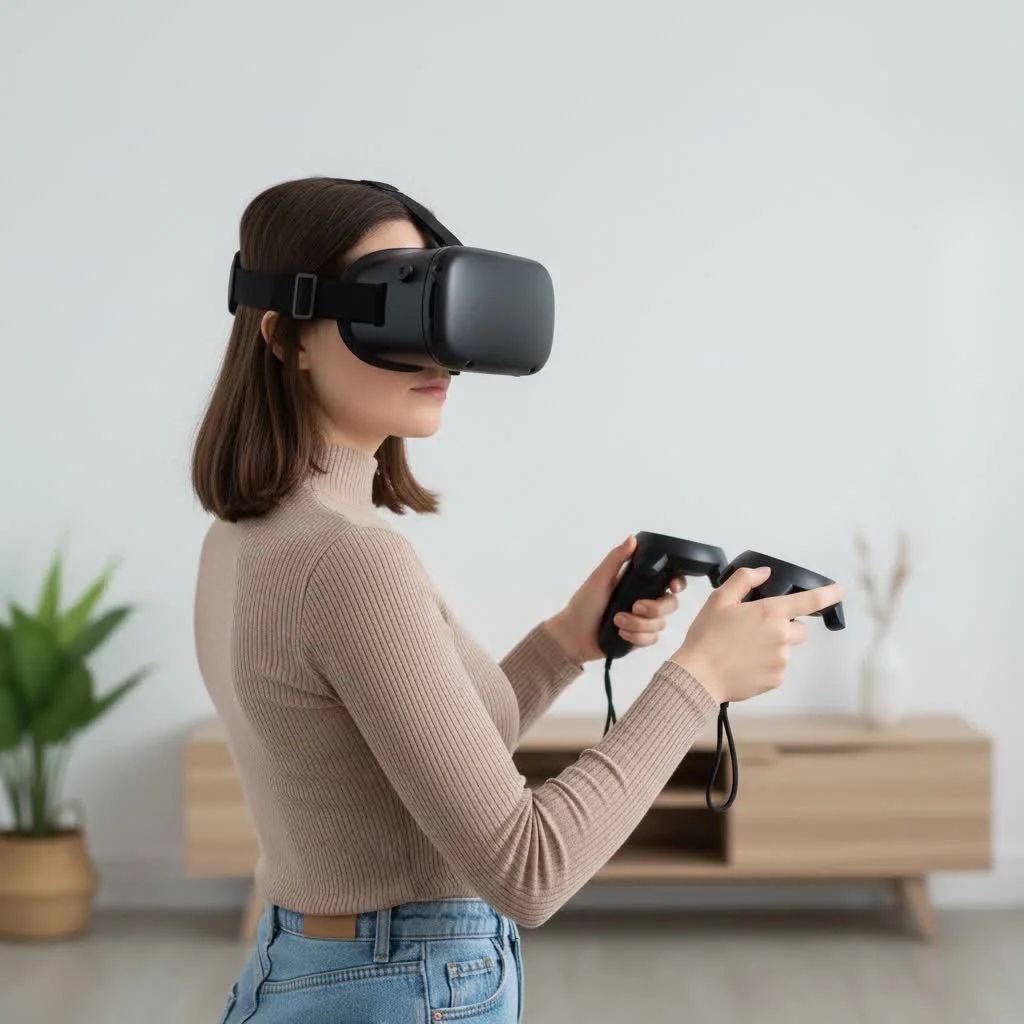
This article explores the legacy of the Rift VR headset, from its groundbreaking beginnings to its final iteration, the Rift S. We’ll cover its key features, its impact on the industry, and answer the crucial question: does it still have a place in today’s market? For browse all virtual reality articles on this site.
What Exactly Was the Oculus Rift?
The Oculus Rift wasn’t just a single product, but a series of PC-tethered VR headsets that evolved over time. Its journey started with a wildly successful Kickstarter campaign in 2012, which promised to deliver a high-quality, low-latency VR experience previously unavailable to the public. This initial spark led to its acquisition by Facebook (now Meta) in 2014, a move that supercharged its development.
The first consumer version, known as the CV1, launched in 2016. It required external sensors, called “Constellation” trackers, to be placed around the room to track the headset and its Touch controllers. While effective, this setup could be cumbersome.
This led to the development and release of its successor in 2019: the Oculus Rift S. This model was a significant upgrade in terms of user-friendliness, replacing the external sensor system with a more streamlined “inside-out” tracking method, making it a pivotal device in the Rift VR headset lineup.
The Oculus Rift S: Key Features and Innovations
The Rift S represented the peak of the Rift line and introduced features that have become standard in modern VR. It was designed to lower the barrier to entry for high-fidelity PC VR, making it easier to set up and use without sacrificing the quality of the experience.
Inside-Out Tracking with Oculus Insight
The most significant upgrade in the Rift S was the move to Oculus Insight tracking. Instead of using external cameras to track your position, the headset used five built-in cameras to scan the room and determine its location and the location of the controllers.
- Ease of Setup: This eliminated the need to mount sensors, drastically simplifying the setup process. You could take your Rift S to a different room or a friend’s house and be up and running in minutes.
- Freedom of Movement: Without the constraint of keeping external sensors in view, users had more freedom to move, though the tracking was most reliable within the cameras’ field of view.
Passthrough+ for Enhanced Awareness
|
Our Picks for the Best VR Headset in 2026
As an Amazon Associate I earn from qualifying purchases.
|
||
| Num | Product | Action |
|---|---|---|
| 1 | PlayStation VR2 Horizon Call of The Mountain™ Bundle (PSVR2) |

|
| 2 | PlayStation VR2 (PSVR2) |
|
| 3 | FEEBZ 3D VR Headset for Kids 2.0 + Android Remote - for iPhone & Android Phones - with 3D VR Videos & Apps Links - Virtual Reality Goggles Set for Beginners |
|
| 4 | Oculus Quest 2 Advanced All-in-One Virtual Reality Gmaing VR Headset 128GB Set, White |
|
| 5 | DESTEK V5 VR Headset for Kids w/VR Gamepad, 128 Premium VR apps Included, Anti-Blue Eyes Protected HD Lenses, 110° FOV Virtual Reality Headsets for iPhone, Android Phone- Black |
|
| 6 | Oculus Quest 2 VR Headset 128GB Holiday Set - Advanced All-in-One Virtual Reality Headset Cover Set, White |
|
| 7 | VR Headset for Nintendo Switch 2 (2025), Switch 2 Virtual Reality VR Glasses with Adjustable HD Lenses and Comfortable Head Strap, Labo VR Kit 3D Goggles for Switch 2 Accessories, White&Blue |
|
| 8 | FEEBZ 3D VR Headset for Kids 2.0 + Android Remote - for iPhone & Android Phones - with 3D VR Videos & Apps Links - Virtual Reality Goggles Set for Beginners |
|
| 9 | Meta Quest 2 — Advanced All-In-One Virtual Reality Headset — 256 GB (Renewed) |
|
| 10 | VR Headset for Phone, Virtual Reality Glasses with Bluetooth Headphones for Adults and Kids Play 3D VR Games Movies (White VR Only) |
|
The cameras used for tracking also enabled a crucial safety and convenience feature called Passthrough+. This system allowed you to see a real-time, stereoscopic view of your physical surroundings without taking off the headset. It was an early version of the mixed-reality views that are central to devices like the Meta Quest 3. This was perfect for grabbing a drink, checking your phone, or ensuring you didn’t trip over the family pet.
The Guardian System
A hallmark of the Oculus platform, the Guardian system was a critical safety feature refined in the Rift S. During setup, you would “paint” a virtual boundary around your safe play area. If you got too close to this boundary while in VR, a virtual grid would appear, warning you that you were about to step into the physical world. This simple but brilliant feature has prevented countless collisions and has been adopted by virtually every VR system since.
As our in-house ergonomics specialist, Dr. Evelyn Reed, often notes, “The Guardian system wasn’t just a feature; it was a fundamental shift in user safety psychology for VR. It allowed users to achieve full immersion with a subconscious safety net, which is critical for user adoption and long-term engagement.”
The End of an Era: Why Was the Rift Discontinued?
Despite the success and popularity of the Rift S, Meta made the strategic decision to discontinue the entire Rift VR headset line in 2021. The focus shifted entirely to their standalone VR headsets, namely the Oculus Quest (now Meta Quest) series.
The reasoning was clear: the future of consumer VR was wireless. Standalone headsets like the Quest 2 offered a compelling “all-in-one” experience without the need for a powerful, expensive gaming PC or any tethering cables. While the Quest could still connect to a PC via Oculus Link (now Air Link) to play PC VR titles, its primary function as a standalone device made it far more accessible to a broader audience. The Rift, being a PC-only device, became redundant in Meta’s new wireless-first strategy.
Should You Still Buy a Rift VR Headset Today?
This is a common question, especially as used Rift S models appear on second-hand markets at tempting prices. For the vast majority of people, the answer is no.
While the Rift S was a fantastic device in its time, buying one today comes with significant drawbacks:
- Discontinued Product: It is no longer manufactured or sold officially. Support is minimal, and replacement parts, like the proprietary tether cable, are notoriously difficult and expensive to find.
- Outdated Technology: The display resolution, refresh rate, and tracking technology have been surpassed by newer, more affordable headsets.
- Better Alternatives: Modern headsets offer superior experiences. The Meta Quest 3, for instance, provides higher resolution, full-color passthrough for mixed reality, and the flexibility of being both a standalone device and a PC VR headset, all without the need for a physical tether.
For collectors or historical enthusiasts, a Rift might be a worthy purchase. But for anyone looking to get into VR gaming or development, your money is much better spent on a current-generation headset.
Modern Alternatives to the Rift VR Headset
If you’re looking for the high-fidelity PC VR experience that the Rift pioneered, you have several excellent modern options.
| Headset | Key Advantage | Tethering |
|---|---|---|
| Meta Quest 3 | Unmatched versatility, mixed reality, great value. | Wireless (Air Link) or Wired (Link Cable) |
| Valve Index | “Best-in-class” tracking, audio, and controllers. | Wired (Requires Base Stations) |
| HP Reverb G2 | Ultra-high resolution for simulation enthusiasts. | Wired |
| Pico 4 | Strong Quest competitor with a focus on comfort. | Wireless or Wired |
The Meta Quest 3 is arguably the direct spiritual successor, offering the best of both worlds: the freedom of standalone VR and the power of PC VR, all in one package.
Frequently Asked Questions (FAQ)
Is the Oculus Rift S officially discontinued?
Yes, Meta officially discontinued sales of the Oculus Rift S in 2021. The product is no longer in production, and official support is limited.
Can you still use an Oculus Rift S in 2025?
Yes, if you have a working Rift S and a compatible PC, it will still function with the Oculus PC software. However, finding replacement parts, especially the cable, can be extremely difficult and costly if anything breaks.
What headset replaced the Oculus Rift S?
Meta did not release a direct “Rift 2.” Instead, their focus shifted to the Quest line. The Meta Quest 2 and now the Meta Quest 3 are considered the successors, offering PC VR capabilities through Air Link and a dedicated Link Cable.
Does the Rift S require a powerful PC?
Yes, absolutely. The Rift VR headset is not a standalone device. It must be connected to a gaming PC that meets the minimum required specifications to run VR applications and games. The headset itself has no onboard processing power.
Was the original Rift better than the Rift S?
This is debatable. The original Rift (CV1) had OLED screens with deeper blacks, but a lower resolution. The Rift S had a higher-resolution LCD screen but some users missed the richness of OLED. However, the inside-out tracking and simplified setup of the Rift S made it a more convenient and user-friendly device for most people.
Conclusion: Honoring a Virtual Reality Legend
The Rift VR headset was more than just a piece of hardware; it was a statement. It proved that compelling, immersive, and comfortable virtual reality was possible for consumers. From its game-changing Kickstarter to the user-friendly design of the Rift S, it laid the groundwork for the entire VR ecosystem we enjoy today. While we wouldn’t recommend buying one now, its spirit lives on in every modern headset that offers room-scale tracking and intuitive controls. The Rift walked so that the Quest could run, and for that, it will always be a celebrated icon in the history of technology.
Get our weekly buyer guide
Practical specs, not advice. Unsubscribe anytime.
I remember getting my original Rift back in 2016 and being absolutely blown away. The inside-out tracking on the Rift S was a huge step up, making setup so much easier without all those external sensors. It really did make high-fidelity VR more accessible for a lot of people, myself included. Good to see its impact still being recognized.
While the Rift S was great for its time, I have to agree that it’s not really worth buying today. The lack of support is a real issue, and the technology just feels a bit outdated compared to newer headsets. I had some issues with the Guardian system being a bit finicky sometimes, which was annoying. Still, it was a solid entry point into VR for many.
The Oculus Rift S was my first real VR experience, and it totally hooked me. The PC-tethered aspect meant amazing graphics for games like Half-Life: Alyx. It’s a shame it’s discontinued, but its legacy is clear in how much modern VR has improved. Definitely a pioneer in the consumer VR space.
I loved my Rift S! It was a game-changer for me, especially with how it handled room-scale VR. The innovations it brought, like the improved tracking, really set the stage for what we have now. Even though it’s not recommended for purchase now, it holds a special place in my tech history.