Have you ever wondered what lies beyond the consumer-grade virtual reality you see in stores? While headsets like the Meta Quest 3 and Apple Vision Pro push boundaries for everyday users, a completely different class of device exists in the world of professional enterprise. The journey to find the most expensive VR headset isn’t just about finding a high price; it’s about discovering a level of technology that is actively shaping the future of industries from automotive design to pilot training. These are not toys; they are powerful simulation tools where cost is secondary to performance.
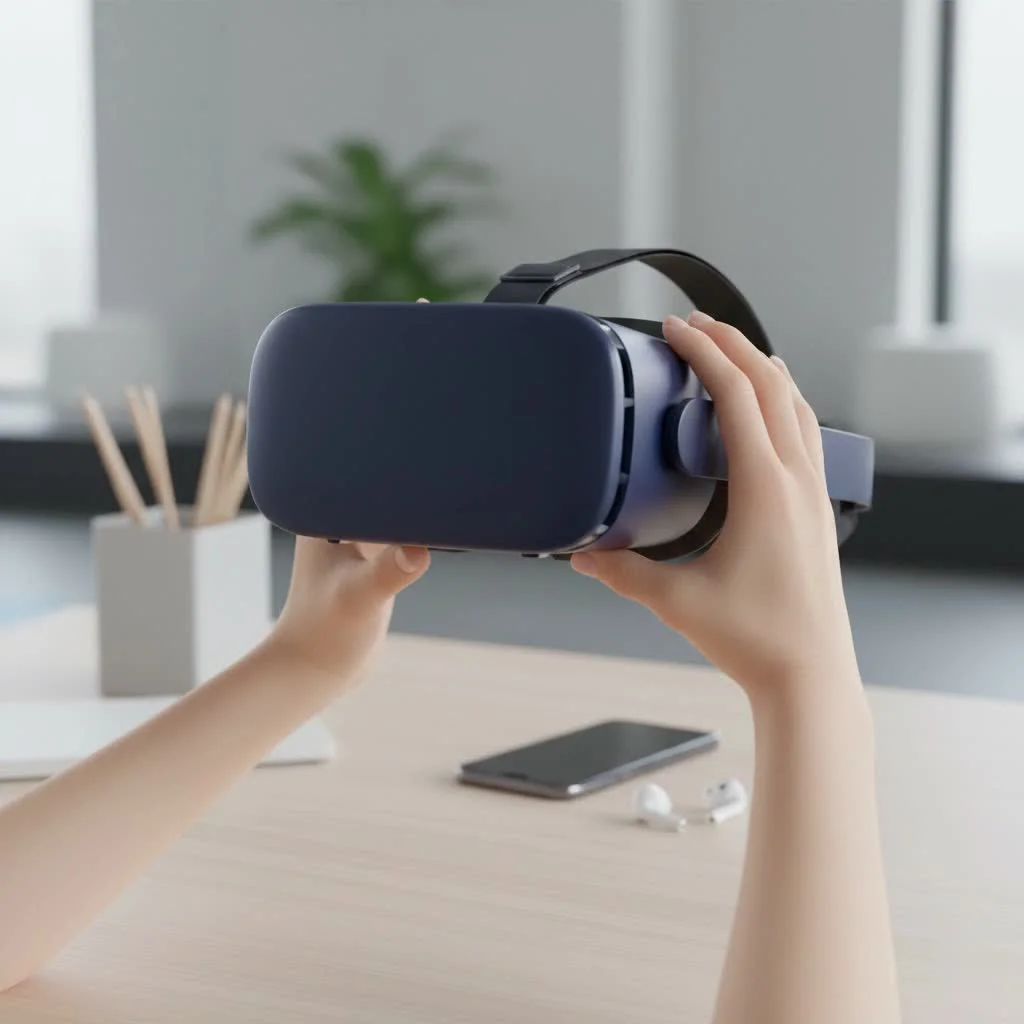
What Separates a $500 Headset from a $10,000+ Device?
The chasm between a consumer VR headset and an enterprise-grade one is vast. The price difference is not arbitrary but is a direct reflection of cutting-edge technology, specialized components, and extensive research and development. While a consumer device is built for entertainment, a professional one is built for precision.
Key differentiators include:
- Visual Fidelity: Enterprise headsets boast resolutions that mimic human eyesight, often referred to as “retinal resolution.” They use advanced display technologies like Mini-LED or micro-OLED to deliver unparalleled brightness, contrast, and color accuracy, completely eliminating the “screen door effect” seen on cheaper models.
- Optics and Field of View (FOV): These devices use custom-engineered, non-fresnel lenses that provide edge-to-edge clarity. Many prioritize an ultra-wide field of view to create a level of immersion that is critical for realistic simulations.
- Advanced Tracking and Sensors: Beyond standard head and hand tracking, the most expensive VR headsets feature high-fidelity eye-tracking for foveated rendering (where the device only renders what the user is looking at in full detail), and advanced passthrough cameras for seamless mixed reality (MR).
- Build Quality and Materials: Built for demanding environments, these headsets use premium, durable materials designed for long hours of continuous use.
- Software and Support: The price often includes specialized software, developer kits (SDKs), and dedicated enterprise-level customer support.
The Contenders for the Most Expensive VR Headset Title
While prices can fluctuate, two names consistently appear at the pinnacle of the VR market: Varjo and Vrgineers. These companies cater almost exclusively to professional and military clients who require the absolute best in immersive technology.
Varjo XR-4 Series: The Pinnacle of Visual Fidelity
Finland-based Varjo has made a name for itself by chasing the goal of creating virtual and mixed reality experiences that are indistinguishable from real life. Their XR-4 series is a testament to this mission.
The Varjo XR-4 Standard Edition starts at around $3,990, but the true powerhouse is the XR-4 Focal Edition, which comes in at a staggering $9,990. The Focal Edition adds autofocus cameras to its mixed reality passthrough system, allowing a user’s eyes to focus on real and virtual objects at varying distances, just as they would in the real world. For certain advanced features and support, Varjo also offers a professional subscription, which can add thousands more to the overall cost. With dual 4K by 4K mini-LED displays and a resolution density that peaks at 51 pixels per degree (PPD), it offers a level of clarity that makes reading text on virtual instruments as clear as it would be on a physical dashboard.
Vrgineers XTAL 3: Built for the Most Demanding Simulations
|
Our Picks for the Best VR Headset in 2026
As an Amazon Associate I earn from qualifying purchases.
|
||
| Num | Product | Action |
|---|---|---|
| 1 | FEEBZ 3D VR Headset for Kids 2.0 + Android Remote - for iPhone & Android Phones - with 3D VR Videos & Apps Links - Virtual Reality Goggles Set for Beginners |

|
| 2 | FEEBZ 3D VR Headset for Kids 2.0 + Android Remote - for iPhone & Android Phones - with 3D VR Videos & Apps Links - Virtual Reality Goggles Set for Beginners |
|
| 3 | Oculus Quest 2 VR Headset 128GB Holiday Set - Advanced All-in-One Virtual Reality Headset Cover Set, White |
|
| 4 | VR Headset for Phone, Virtual Reality Glasses with Bluetooth Headphones for Adults and Kids Play 3D VR Games Movies (White VR Only) |
|
| 5 | VR Headset for Nintendo Switch 2 (2025), Switch 2 Virtual Reality VR Glasses with Adjustable HD Lenses and Comfortable Head Strap, Labo VR Kit 3D Goggles for Switch 2 Accessories, White&Blue |
|
| 6 | DESTEK V5 VR Headset for Kids w/VR Gamepad, 128 Premium VR apps Included, Anti-Blue Eyes Protected HD Lenses, 110° FOV Virtual Reality Headsets for iPhone, Android Phone- Black |
|
| 7 | Meta Quest 2 — Advanced All-In-One Virtual Reality Headset — 256 GB (Renewed) |
|
| 8 | PlayStation VR2 (PSVR2) |
|
| 9 | Oculus Quest 2 Advanced All-in-One Virtual Reality Gmaing VR Headset 128GB Set, White |
|
| 10 | PlayStation VR2 Horizon Call of The Mountain™ Bundle (PSVR2) |
|
Vrgineers is another heavyweight in the professional VR space, focusing heavily on the aviation and defense sectors. Their XTAL 3 headset is an engineering marvel designed for maximum immersion and situational awareness, particularly for pilot training.
The VR version of the XTAL 3 is priced around $9,000, while the Mixed Reality model climbs to over $11,500. The defining feature of the XTAL 3 is its incredible 180-degree horizontal field of view, which nearly matches human peripheral vision. This wide FOV is crucial for flight simulators, where a pilot needs to be able to glance out the side of a cockpit. It combines this with a 4K resolution per eye and advanced eye-tracking to deliver a seamless, high-fidelity experience without requiring a recurring subscription fee.
“In professional simulation, especially for aviation, every pixel and every degree of vision counts,” states Dr. Alistair Finch, a leading expert in simulation technologies. “The cost of these high-end headsets is a direct investment in precision. When you are training a pilot to handle a multi-million dollar aircraft, the simulator must be as close to reality as possible. The price of the headset becomes negligible compared to the cost of an error in the real world.”
Why Do These High-End VR Headsets Cost So Much?
The price tags of the Varjo XR-4 and Vrgineers XTAL 3 are not simply about marking up a product. They reflect the immense costs associated with developing technology at the absolute bleeding edge.
Research & Development (R&D)
These companies pour millions into R&D to create proprietary technologies that solve complex challenges in optics, display technology, and tracking. Developing custom lenses that provide a wide, distortion-free view or creating a mixed reality system with near-zero latency is a monumental undertaking.
Cutting-Edge Components
The most expensive VR headsets do not use off-the-shelf parts. They are built with custom-specified components that are often produced in low volumes, which dramatically increases their cost. This includes things like:
- High-density Mini-LED or micro-OLED displays.
- Custom-ground glass or polymer lenses.
- Advanced sensors for eye, hand, and environmental tracking.
- High-resolution cameras for photorealistic mixed reality.
Enterprise-Grade Support and Software
Unlike consumer products, enterprise headsets come with robust support packages and powerful software designed to integrate into complex professional workflows. The cost covers the specialized teams that help companies in the automotive, aviation, and healthcare industries deploy and maintain these advanced systems.
Is the Most Expensive VR Headset Worth It for You?
For the vast majority of people, the answer is a clear no. These devices are highly specialized tools, not entertainment systems. A gamer would see diminishing returns trying to play a standard VR game on an $11,500 headset, as the software is not optimized to take advantage of its unique capabilities. A consumer headset like the Meta Quest 3 provides a fantastic, accessible experience for gaming and general use.
However, for a professional or a corporation, the value proposition is entirely different. For an automotive company designing a new car, a high-fidelity VR headset that allows designers to sit in a realistic virtual prototype can save millions in physical modeling costs. For a military force, it provides a safe, repeatable, and effective way to train pilots. In these contexts, the most expensive VR headset is not a luxury; it’s a strategic investment that delivers a significant return.
Frequently Asked Questions (FAQ)
What is the most expensive VR headset in the world?
The Vrgineers XTAL 3 Mixed Reality, priced at over $11,500, is one of the most expensive commercially available VR headsets. The Varjo XR-4 Focal Edition is also a top contender at nearly $10,000 before factoring in annual software subscriptions.
Why are some VR headsets so expensive?
They are expensive due to the high cost of research and development, the use of custom, cutting-edge components like retinal-resolution displays and advanced optics, low-volume manufacturing, and the inclusion of specialized enterprise software and support.
Is the most expensive VR headset the best for gaming?
No. While technically impressive, these headsets are built and optimized for professional simulation and design applications, not commercial video games. A high-end consumer headset will provide a better and more compatible experience for gaming.
What do professionals use expensive VR headsets for?
They are used in a wide range of industries for applications like pilot and military training, vehicle and architectural design, advanced medical training for surgeons, and complex scientific visualization.
What is the biggest difference between a consumer and a professional VR headset?
The biggest differences are visual fidelity and the intended use case. Professional headsets prioritize features like retinal resolution, ultra-wide fields of view, and flawless mixed reality for precision simulation, whereas consumer headsets focus on providing an accessible and enjoyable experience for gaming and entertainment.
Get our weekly buyer guide
Practical specs, not advice. Unsubscribe anytime.
This was a super insightful read! I’ve always been curious about the really high-end VR tech beyond what’s available to the average person. Understanding that the cost reflects extensive R&D and specialized components, rather than just a luxury markup, makes a lot of sense. It’s clear these aren’t just ‘toys’ but essential tools shaping the future.
I found the information about the professional enterprise headsets really interesting, especially how they’re used for simulation. However, I was hoping for a bit more detail on specific brands or models in that super high-end category. It felt a little general without naming some of the actual most expensive VR headsets. Still, it was a good overview of why the price tag is so high.
I’ve been following VR for years, and it’s fascinating to see what’s happening in the enterprise space. The article really highlighted how these aren’t just fancy gaming devices but serious tools for industries like automotive design. It makes perfect sense why they cost so much more than a Quest 3 when you consider the precision and specialized components involved. Definitely makes me appreciate the tech even more.
It’s wild to think about the difference between a consumer headset and something that costs upwards of $10,000. I always assumed the Apple Vision Pro was top-tier, but this really opened my eyes to a whole other level of VR. The focus on performance over cost for things like pilot training really puts it into perspective. Great breakdown of what makes these devices so expensive.