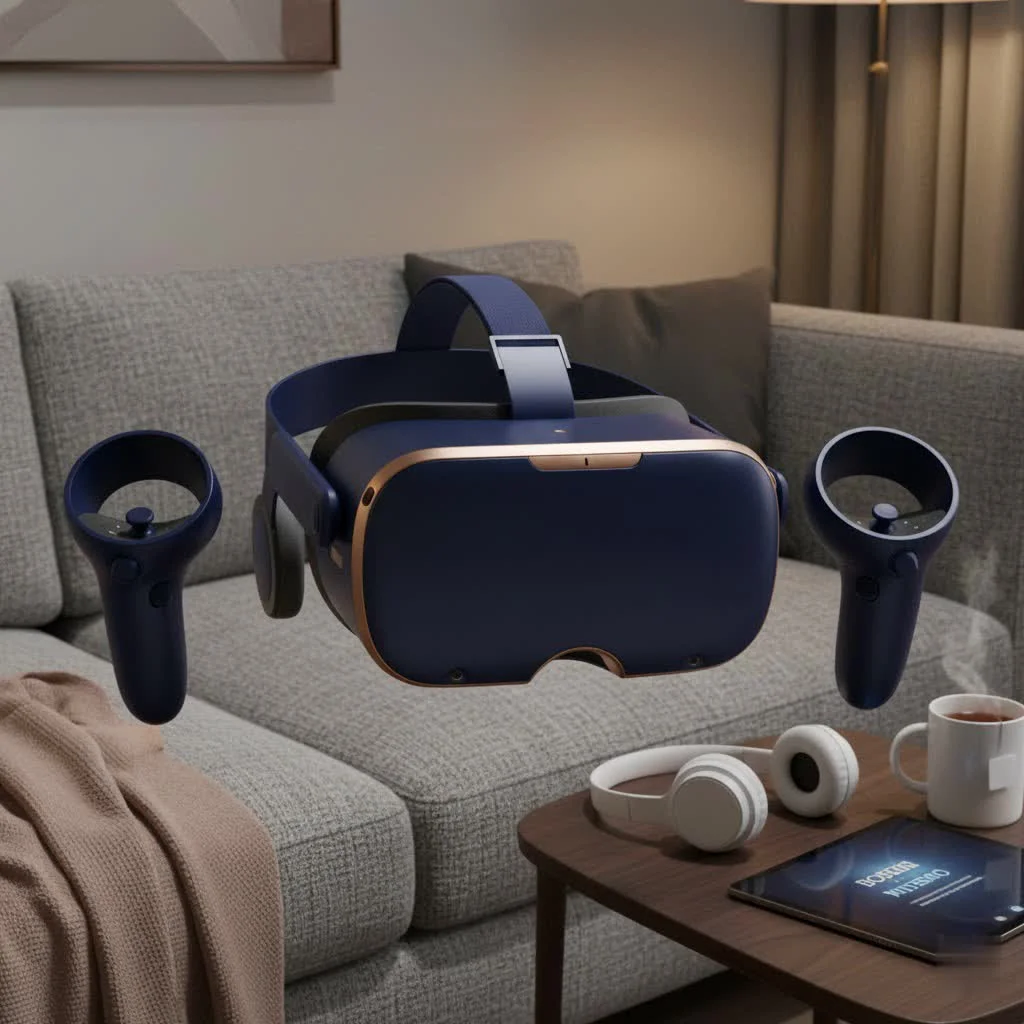
The best VR headset for sim racing is the Meta Quest 3 for its exceptional value, comfort, and impressive visual clarity, making it ideal for most sim racers. For those prioritizing ultimate visual fidelity and with a high-end PC, the Varjo Aero or Pimax Crystal offer unparalleled sharpness and immersion. Virtual reality transforms sim racing by providing true-to-life depth perception and scale, allowing drivers to judge braking points and track elevation with greater accuracy than traditional monitor setups.
 VR headset in a racing cockpit” style=”margin: 20px auto;width: 800px;max-width: 100%;height: auto” />
Having spent over a decade in virtual cockpits, I’ve witnessed VR evolve into an essential tool for serious racers. The right headset enhances the experience, allowing natural glances at mirrors and improved spatial awareness. With numerous options available, selecting the optimal headset can significantly impact your performance and enjoyment. Let’s explore the key factors and top recommendations.
Why is VR a Game-Changer for Sim Racing?
Understanding why VR is so transformative for racing simulators is crucial. It’s not merely a larger screen; it’s a fundamental shift in perception. The primary advantage is true-to-life depth perception and scale. Corners that appear flat on a monitor gain camber and elevation in VR. This allows for more accurate judgment of braking points due to natural, 1:1 scale distance perception, mirroring a real car. This level of spatial awareness is unattainable with a flat screen.
Key Features for the Best VR Headset for Sim Racing
When racing at high speeds, certain VR features are more critical for sim racing than for other VR applications.
Field of View (FOV)
This is arguably the most important factor. A wide Field of View enables the use of peripheral vision to spot other cars, check mirrors with minimal head movement, and enhance the sense of speed. A narrow FOV can feel restrictive, like driving with blinders.
Resolution and Clarity
Clear visibility of distant braking markers and dashboard instruments is essential. High resolution per eye minimizes the “screen-door effect” (visible gaps between pixels), delivering a sharper, more realistic image. Headsets with high Pixels Per Degree (PPD) are recommended.
Refresh Rate
A higher refresh rate (measured in Hz) provides a smoother image. For the rapid motion of sim racing, a minimum of 90Hz is recommended to reduce motion blur and prevent motion sickness. Many premium headsets now offer 120Hz or higher, which significantly improves the experience.
Comfort and Weight
Headsets are worn for extended periods, potentially hours. A lightweight, well-balanced design with comfortable padding is crucial. An uncomfortable headset can quickly detract from the immersive experience.
The Top VR Headsets for Sim Racing
Here are the top picks, categorized by their strengths. These headsets have been extensively tested with titles such as iRacing, Assetto Corsa Competizione, and Automobilista 2.
The Ultimate Clarity Pick: Varjo Aero
|
Our Picks for the Best VR Headset in 2026
As an Amazon Associate I earn from qualifying purchases.
|
||
| Num | Product | Action |
|---|---|---|
| 1 | DESTEK V5 VR Headset for Kids w/VR Gamepad, 128 Premium VR apps Included, Anti-Blue Eyes Protected HD Lenses, 110° FOV Virtual Reality Headsets for iPhone, Android Phone- Black |

|
| 2 | FEEBZ 3D VR Headset for Kids 2.0 + Android Remote - for iPhone & Android Phones - with 3D VR Videos & Apps Links - Virtual Reality Goggles Set for Beginners |
|
| 3 | VR Headset for Phone, Virtual Reality Glasses with Bluetooth Headphones for Adults and Kids Play 3D VR Games Movies (White VR Only) |
|
| 4 | FEEBZ 3D VR Headset for Kids 2.0 + Android Remote - for iPhone & Android Phones - with 3D VR Videos & Apps Links - Virtual Reality Goggles Set for Beginners |
|
| 5 | Meta Quest 2 — Advanced All-In-One Virtual Reality Headset — 256 GB (Renewed) |
|
| 6 | PlayStation VR2 (PSVR2) |
|
| 7 | PlayStation VR2 Horizon Call of The Mountain™ Bundle (PSVR2) |
|
| 8 | Oculus Quest 2 Advanced All-in-One Virtual Reality Gmaing VR Headset 128GB Set, White |
|
| 9 | VR Headset for Nintendo Switch 2 (2025), Switch 2 Virtual Reality VR Glasses with Adjustable HD Lenses and Comfortable Head Strap, Labo VR Kit 3D Goggles for Switch 2 Accessories, White&Blue |
|
| 10 | Oculus Quest 2 VR Headset 128GB Holiday Set - Advanced All-in-One Virtual Reality Headset Cover Set, White |
|
For those demanding the sharpest image, the Varjo Aero stands out. It was designed with professional applications in mind, which is evident in its performance.
- Why it’s great: The Aero’s key feature is its incredible “retina resolution” display in the central view. Dashboard text is perfectly crisp, and distant track details are visible with unparalleled clarity. It also includes automatic IPD (inter-pupillary distance) adjustment for optimal lens alignment.
- Things to consider: It carries a premium price and requires a powerful PC for full performance. It also lacks integrated audio or controllers, necessitating separate purchases.
The All-Rounder Champion: Pimax Crystal
Pimax is known for pushing VR boundaries, and the Crystal is their most refined product. It combines high resolution with a wide field of view.
- Why it’s great: The Pimax Crystal features one of the highest pixel counts available, providing an incredibly sharp and vibrant picture across a wide FOV. It offers interchangeable lenses to prioritize either maximum clarity (35 PPD) or a wider view. High-quality audio and robust tracking complete the package.
- Things to consider: Similar to the Aero, it’s a demanding headset requiring a high-end graphics card. It is also heavier, though its weight distribution is well-managed.
The Best Value Proposition: Meta Quest 3
Despite its mainstream appeal, the Meta Quest 3 is a highly capable headset for PC-based sim racing, offering performance beyond its price point.
- Why it’s great: The Quest 3’s “pancake” lenses deliver excellent edge-to-edge clarity, a significant improvement over older Fresnel lenses. It is lightweight, comfortable, and easy to set up via a wired Link cable or wirelessly with Air Link. Its visual quality and versatility are unmatched for its price.
- Things to consider: For the best experience, a high-quality Link cable or a robust Wi-Fi 6E network for wireless play is recommended. There will be some video compression, which, while excellent, is not as pristine as a native DisplayPort connection.
“In sim racing, your peripheral vision is just as important as what’s directly in front of you,” says Alex “Apex” Foster, a veteran sim racing league champion. “A high-FOV headset doesn’t just make it more immersive; it makes you safer and more aware on track. You can sense the car alongside you without having to fully turn your head, which is a massive competitive advantage.”
How to Optimize Your VR Setup for Racing
Acquiring the best VR headset for sim racing is only part of the process. To maximize its potential, optimizing your settings is essential.
- Prioritize Frame Rate: Always aim for a stable frame rate that matches your headset’s refresh rate (e.g., 90 fps for a 90Hz headset). Fluctuating frame rates cause stuttering and motion sickness. Reduce graphical settings like shadows or post-processing before sacrificing frame rate.
- Find Your Graphics Sweet Spot: Avoid simply setting everything to ultra. Begin with lower settings and gradually increase them. Pay close attention to Super Sampling or Render Resolution, as this setting has the greatest impact on clarity but is also the most demanding.
- Map Essential Controls: Assign buttons on your steering wheel for recentering your VR view and navigating game menus. Removing your headset to use a mouse disrupts immersion.
Frequently Asked Questions (FAQ)
What is the most important specification for a sim racing VR headset?
While resolution is important, the Field of View (FOV) significantly impacts immersion and situational awareness. A wide FOV helps you feel more naturally “in” the car and allows you to spot opponents alongside you more easily.
Do I need a powerful PC for VR sim racing?
Yes, VR sim racing is one of the most demanding applications for a gaming PC. A modern, high-end graphics card (such as an NVIDIA RTX 4070 or better) and a strong CPU are necessary to maintain a smooth and stable frame rate.
Can I wear prescription glasses with a VR headset?
Most modern headsets accommodate glasses, often with a spacer for extra room. However, for optimal comfort and to prevent scratching the headset’s lenses, custom prescription lens inserts are highly recommended.
How can I reduce motion sickness during VR racing?
To reduce motion sickness, start with short sessions and gradually increase duration. Ensure your PC maintains a high, stable frame rate, as stuttering is a primary cause. Additionally, focus on looking far down the track into corners, similar to real-world driving.
Making Your Final Decision
Choosing the best VR headset for sim racing depends on your budget and priorities. For dedicated enthusiasts seeking ultimate visual fidelity with a top-tier PC, the Varjo Aero or Pimax Crystal are exceptional choices, representing the pinnacle of current consumer VR technology.
However, for the majority of sim racers, the Meta Quest 3 provides an incredible, immersive experience at a significantly lower cost. Its ease of use, comfort, and impressive visual clarity make it the best all-around value and a top recommendation for those entering VR racing without a large investment. Regardless of your choice, you’re about to experience your favorite racing sims in an entirely new way. See you on the track.
Optimize Your VR Setup for Sim Racing
To get the most out of your VR headset for sim racing, follow these steps to optimize your settings for performance and immersion.
Always aim for a stable frame rate that matches your headset's refresh rate, such as 90 frames per second for a 90Hz headset. A fluctuating frame rate can cause stuttering and motion sickness. Reduce graphical settings like shadows or post-processing before sacrificing frame rate stability.
Do not simply set all graphics options to ultra. Begin with lower settings and gradually increase them to find the optimal balance for your system. Pay close attention to Super Sampling or Render Resolution, as this setting has the greatest impact on clarity but is also the most demanding on your hardware.
Assign buttons on your steering wheel for critical functions like recentering your VR view and navigating game menus. Having to remove your headset to use a mouse or keyboard will break immersion and is inefficient during a race.
Get our weekly buyer guide
Practical specs, not advice. Unsubscribe anytime.
I was really hyped for the Varjo Aero, and while the visual fidelity is insane, I’ve had some issues with the software. It’s not always the most user-friendly, and I’ve experienced a few glitches that pull me out of the experience. When it works, it’s amazing, but the occasional hiccups are a bit frustrating for such a premium price point. Still, the depth perception is unmatched.
Upgraded to the Meta Quest 3 from an older headset, and the difference for sim racing is night and day. The comfort is a huge plus, and I can wear it for hours without any discomfort. Being able to naturally glance at mirrors makes such a huge difference in races. It’s truly transformed my iRacing experience.
I’ve been using a Pimax Crystal for a few months now, and the sharpness is truly next level. My high-end PC handles it well, and the immersion in Assetto Corsa Competizione is just incredible. The only reason it’s not a 5-star is that it took a bit of tweaking to get it perfectly dialed in, but once it was, wow. It really does make a difference for spatial awareness.
I finally pulled the trigger on the Meta Quest 3 after reading about its value for sim racing, and I’m blown away. The visual clarity is fantastic, and it’s so comfortable even during long sessions. Judging braking points feels so much more natural now compared to my old monitor setup. Definitely recommend it if you’re looking for a great all-around headset without breaking the bank.