Welcome to the future, right here in your living room. The world of virtual reality is expanding at a breathtaking pace, and the gateway to these incredible new worlds is a Vr Headset. If you’re ready to dive in, you’ve come to the right place. With over a decade of experience navigating the digital frontiers of VR, I’m here to demystify the technology and guide you through choosing the perfect device for your adventures.
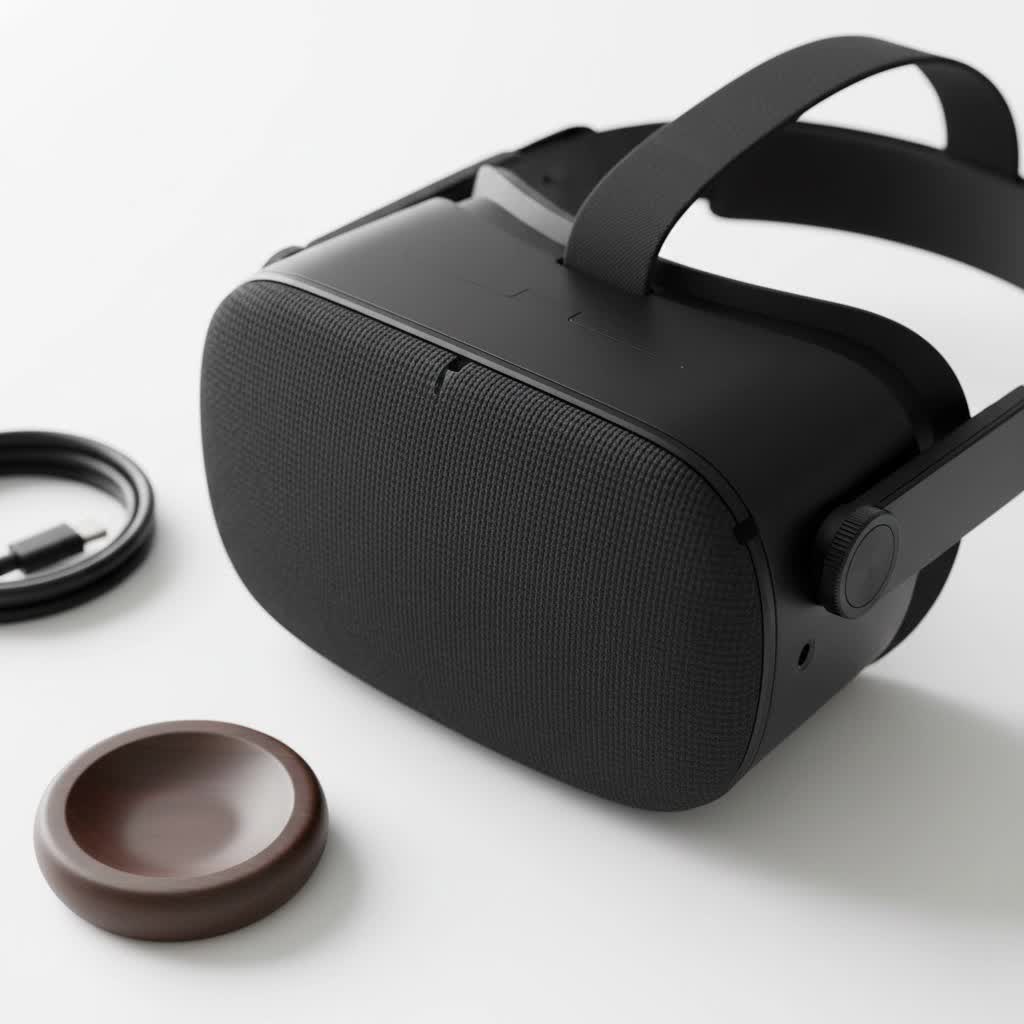
A VR headset is more than just a screen you wear; it’s a sophisticated piece of technology designed to trick your brain into believing you are somewhere else entirely. It does this by using two high-resolution screens—one for each eye—to create a stereoscopic 3D image. Combined with advanced motion tracking that follows your head movements in real-time, the virtual world moves as you do, creating a powerful sense of presence. Add in 3D spatial audio and haptic feedback controllers, and your senses are fully immersed in a new reality.
What is a VR Headset and How Does It Work?
At its core, a VR headset is a head-mounted display that blocks out the physical world to immerse you in a digital one. The magic lies in a symphony of carefully engineered components working together.
It starts with the visuals. By displaying two slightly different images to each eye, the headset mimics how we naturally perceive depth, creating a convincing three-dimensional world. Special lenses, often Fresnel lenses, are used to focus and widen the field of view from these up-close screens, making the virtual world feel expansive.
But it’s the tracking that sells the illusion. Using a combination of internal sensors like accelerometers and gyroscopes, along with outward-facing cameras (a technique called inside-out tracking), the headset knows exactly where you are looking and how you are moving. This is known as six degrees of freedom (6DoF), allowing you to not just look around but also walk, duck, and lean within your virtual space. Any lag here would shatter the illusion, which is why a high refresh rate is crucial for a smooth and comfortable experience.
Types of VR Headsets: Which One is Right for You?
VR headsets generally fall into three main categories, each with distinct advantages. Understanding the difference is the first step in finding your perfect match.
Standalone VR Headsets
Standalone headsets are the most accessible and popular entry point into VR. These all-in-one devices have all the computing power, storage, and batteries built right in. There are no cables to trip over and no need for an external computer or console. This freedom makes for an incredibly intuitive and liberating experience.
- Pros: Completely wireless, easy to set up, portable, and generally more affordable.
- Cons: Less processing power than PC-based systems, which can mean less detailed graphics.
- Examples: Meta Quest 3.
|
Our Picks for the Best VR Headset in 2026
As an Amazon Associate I earn from qualifying purchases.
|
||
| Num | Product | Action |
|---|---|---|
| 1 | FEEBZ 3D VR Headset for Kids 2.0 + Android Remote - for iPhone & Android Phones - with 3D VR Videos & Apps Links - Virtual Reality Goggles Set for Beginners |

|
| 2 | VR Headset for Phone, Virtual Reality Glasses with Bluetooth Headphones for Adults and Kids Play 3D VR Games Movies (White VR Only) |
|
| 3 | Meta Quest 2 — Advanced All-In-One Virtual Reality Headset — 256 GB (Renewed) |
|
| 4 | DESTEK V5 VR Headset for Kids w/VR Gamepad, 128 Premium VR apps Included, Anti-Blue Eyes Protected HD Lenses, 110° FOV Virtual Reality Headsets for iPhone, Android Phone- Black |
|
| 5 | PlayStation VR2 (PSVR2) |
|
| 6 | VR Headset for Nintendo Switch 2 (2025), Switch 2 Virtual Reality VR Glasses with Adjustable HD Lenses and Comfortable Head Strap, Labo VR Kit 3D Goggles for Switch 2 Accessories, White&Blue |
|
| 7 | FEEBZ 3D VR Headset for Kids 2.0 + Android Remote - for iPhone & Android Phones - with 3D VR Videos & Apps Links - Virtual Reality Goggles Set for Beginners |
|
| 8 | PlayStation VR2 Horizon Call of The Mountain™ Bundle (PSVR2) |
|
| 9 | Oculus Quest 2 VR Headset 128GB Holiday Set - Advanced All-in-One Virtual Reality Headset Cover Set, White |
|
| 10 | Oculus Quest 2 Advanced All-in-One Virtual Reality Gmaing VR Headset 128GB Set, White |
|
PC VR Headsets
For those who crave the highest visual fidelity and most complex virtual experiences, PC VR is the pinnacle. These headsets tether to a powerful gaming computer, leveraging its high-end graphics card and processor to render incredibly detailed and realistic virtual worlds. While some offer wireless adapters, they traditionally rely on a physical cable.
- Pros: Unmatched graphical performance, access to a massive library of high-end games and applications.
- Cons: Requires an expensive, powerful PC; setup can be more complex, and the tether can restrict movement.
- Examples: Valve Index, HTC Vive Pro 2.
Console VR Headsets
Occupying a middle ground, console-based VR offers a streamlined, high-quality experience powered by a gaming console. This option provides a plug-and-play approach that is more powerful than standalone headsets but less complex and costly than a full PC VR setup.
- Pros: Simpler setup than PC VR, excellent performance for the price, and exclusive, high-quality games.
- Cons: Requires a specific game console and is tied to that console’s ecosystem.
- Example: PlayStation VR2 (requires a PlayStation 5).
Key Features to Look for in a VR Headset
When comparing models, the technical specifications can seem daunting. Let’s break down the most important features that will impact your experience.
Resolution and Display
Resolution, often measured in “pixels per eye,” determines the clarity and sharpness of the image. Higher resolution reduces the “screen door effect,” where the fine lines between pixels become visible. Look for headsets with a high pixel count for the most realistic and crisp visuals.
Refresh Rate
Measured in Hertz (Hz), the refresh rate is how many times the screen updates per second. A higher refresh rate (90Hz or above) results in smoother motion and is critical for preventing motion sickness. For fast-paced games, a rate of 120Hz or even 144Hz can make a significant difference.
Field of View (FOV)
Field of View refers to how much of the virtual world you can see at any given moment. A wider FOV is more immersive because it fills more of your peripheral vision, making it feel less like you’re looking through binoculars. Most consumer headsets offer an FOV between 100 and 110 degrees.
Tracking and Controllers
Modern VR relies on 6DoF inside-out tracking, which uses cameras on the headset to track your position in the room without external sensors. This is the standard for convenience and freedom of movement. The controllers are your hands in the virtual world; they should be ergonomic and provide intuitive controls and haptic feedback to enhance immersion.
“The goal of modern VR is to achieve ‘presence’—that gut feeling you are truly somewhere else. This is only possible when every component, from the display’s refresh rate to the tracking’s accuracy, works in perfect harmony to create a seamless feedback loop with the user’s brain.” – Dr. Alistair Finch, Human-Computer Interaction Specialist
What Can You Do With a VR Headset?
While gaming is the most prominent application, the possibilities in VR are virtually limitless.
- Gaming: Step inside blockbuster games, from epic adventures to competitive shooters.
- Fitness: Turn your workout into a game with interactive fitness apps that make exercise genuinely fun.
- Social: Meet and interact with people from around the world in virtual social platforms, attend live events, or watch movies together.
- Creativity: Sculpt, paint, and design in a 3D space with intuitive motion controls.
- Education and Training: Visit historical sites, explore the human body, or practice complex skills in a safe, simulated environment.
Frequently Asked Questions (FAQ)
Q: Do I need a lot of space to use a VR headset?
A: Not necessarily. Most headsets have a “stationary mode” that allows you to play while seated or standing in one spot. For “room-scale” experiences, which let you walk around, you’ll need a clear area of at least 6.5 by 6.5 feet (2 by 2 meters).
Q: Can I wear glasses with a VR headset?
A: Most modern headsets are designed to accommodate glasses, often including a spacer to provide extra room. For the best comfort, you can also purchase custom prescription lens inserts that fit directly into the headset.
Q: Will VR make me feel sick?
A: VR-induced motion sickness can happen when there’s a disconnect between what your eyes see and what your inner ear feels. However, technology has improved dramatically. High refresh rates, low latency, and comfort settings within games (like teleportation movement) have made this much less common for most users.
Q: Is a standalone VR headset powerful enough for a good experience?
A: Absolutely. Standalone headsets like the Meta Quest 3 offer incredible experiences that are more than powerful enough for the vast majority of games and applications. While a high-end PC will produce more detailed graphics, the freedom and simplicity of standalone VR are a massive advantage.
Q: What is “mixed reality”?
A: Mixed reality (MR) is a feature on some modern VR headsets, like the Meta Quest 3, that uses high-quality color cameras to show you the real world around you. It can then overlay virtual objects onto your physical space, blending the digital and real worlds.
Your Journey Begins Now
Choosing a VR headset is the first step into a larger world of incredible experiences. Whether you opt for the untethered freedom of a standalone device, the graphical power of a PC VR system, or the streamlined fun of a console headset, you’re on the cusp of a technological revolution. Consider your budget, your available space, and what you most want to do, and use this guide to make an informed choice. The virtual universe is waiting.
